
A restaurant loyalty campaign gives customers a clear reason to choose your restaurant again instead of treating every visit as an isolated purchase. One of the simplest models is a digital stamp campaign: the customer completes a defined number of qualifying purchases and receives a reward.
The important part is not simply offering something for free. A useful campaign should balance the value customers perceive with the actual cost of the reward to the restaurant. This is especially relevant for restaurants because menu price and food cost can be very different numbers.
If you are new to this model, our guide to loyalty card usage in restaurants explains how repeat-purchase rewards fit into a broader restaurant loyalty strategy.
What is a good restaurant loyalty campaign?
A good restaurant loyalty campaign rewards a behavior customers can realistically repeat while keeping the reward economically sustainable for the business. For frequently purchased menu items, a simple structure such as “buy 7, get the 8th free” can make the next reward easy to understand and easy to work toward.
The ideal threshold depends on your food cost, selling price, purchase frequency and the reward you choose. There is no single number that works for every restaurant.
How to calculate a restaurant loyalty reward
Before choosing the number of purchases required for a reward, separate the selling price from the incremental cost of the reward. A free menu item with a $10 selling price does not necessarily cost the restaurant $10 to provide.
Consider a burger that sells for $6 and has an assumed food cost of $3. In a “buy 7 burgers, get the 8th free” campaign, the customer spends $42 before receiving the reward. The restaurant then provides one additional burger with an assumed $3 food cost.
| Metric | Example |
|---|---|
| Selling price | $6 |
| Assumed food cost | $3 |
| Paid purchases required | 7 |
| Customer spend before reward | $42 |
| Additional food cost of free item | $3 |
| Average customer price across 8 burgers | $5.25 |
The $3 reward cost should not be subtracted from the customer's $42 spend to calculate what the customer paid. The customer still paid $42. The $3 is an estimated cost to the restaurant for providing the reward.
8 restaurant loyalty campaign examples
The same basic reward logic can be adapted to different restaurant concepts and menu items. The examples below use simplified food-cost assumptions to show how the structure works.
1. Burger Campaign
Burger price: $6. Assumed cost: $3. Buy 7 burgers and receive the 8th free. Customer spend before the reward: $42. Estimated reward cost: $3.
2. Döner Campaign
Döner price: $8. Assumed cost: $4. Buy 8 and receive the 9th free. Customer spend before the reward: $64. Estimated reward cost: $4.
3. Pizza Campaign
Pizza price: $10. Assumed cost: $5. Buy 6 pizzas and receive the 7th free. Customer spend before the reward: $60. Estimated reward cost: $5.
4. Chicken Menu Campaign
Menu price: $8. Assumed cost: $4. Buy 8 menus and receive the 9th free. Customer spend before the reward: $64. Estimated reward cost: $4.
5. Dessert Campaign
Dessert price: $6. Assumed cost: $3. Buy 7 desserts and receive the 8th free. Customer spend before the reward: $42. Estimated reward cost: $3.
6. Meatball Menu Campaign
Menu price: $8. Assumed cost: $4. Buy 7 menus and receive the 8th free. Customer spend before the reward: $56. Estimated reward cost: $4.
7. Sushi Campaign
Order price: $10. Assumed cost: $5. Complete 6 qualifying orders and receive the 7th qualifying reward free. Customer spend before the reward: $60. Estimated reward cost: $5.
8. Soup Campaign
Soup price: $4. Assumed cost: $2. Buy 7 soups and receive the 8th free. Customer spend before the reward: $28. Estimated reward cost: $2.
Restaurant loyalty campaign calculations compared
Looking at the examples together makes it easier to compare the reward threshold and the implied discount customers receive across the complete purchase cycle.
| Campaign | Price | Paid Purchases | Customer Spend | Free Reward Cost | Average Price Including Reward |
|---|---|---|---|---|---|
| Burger | $6 | 7 | $42 | $3 | $5.25 |
| Döner | $8 | 8 | $64 | $4 | $7.11 |
| Pizza | $10 | 6 | $60 | $5 | $8.57 |
| Chicken Menu | $8 | 8 | $64 | $4 | $7.11 |
| Dessert | $6 | 7 | $42 | $3 | $5.25 |
| Meatball Menu | $8 | 7 | $56 | $4 | $7.00 |
| Sushi Order | $10 | 6 | $60 | $5 | $8.57 |
| Soup | $4 | 7 | $28 | $2 | $3.50 |
Why the reward threshold matters
A loyalty reward should feel achievable without becoming an automatic discount on nearly every purchase. If the threshold is too high, customers may stop paying attention to the campaign. If it is too low, the restaurant may give away more value than its margins comfortably support.
Start with the natural purchase frequency of the product. A customer may buy lunch much more frequently than a premium dinner, for example. The right campaign therefore depends on both economics and customer behavior.
This is also why a campaign should not be confused with the entire loyalty strategy. Our guide to the difference between campaigns and loyalty programs explains how individual offers can work inside a longer-term customer retention system.
Go beyond “buy X, get one free”
Stamp cards are particularly easy to understand for repeat menu purchases, but they are not the only restaurant loyalty model. Letstamp also supports reward points, which can be configured as a fixed amount after a spending threshold or as a percentage of customer spending.
This can be useful when customers regularly order different items or when order values vary significantly. Instead of tracking one specific product, the restaurant can build a campaign around spending. You can learn more about Loyalty Points & Cashback and how this model differs from a stamp-based reward.
Turn repeat purchases into a digital stamp campaign
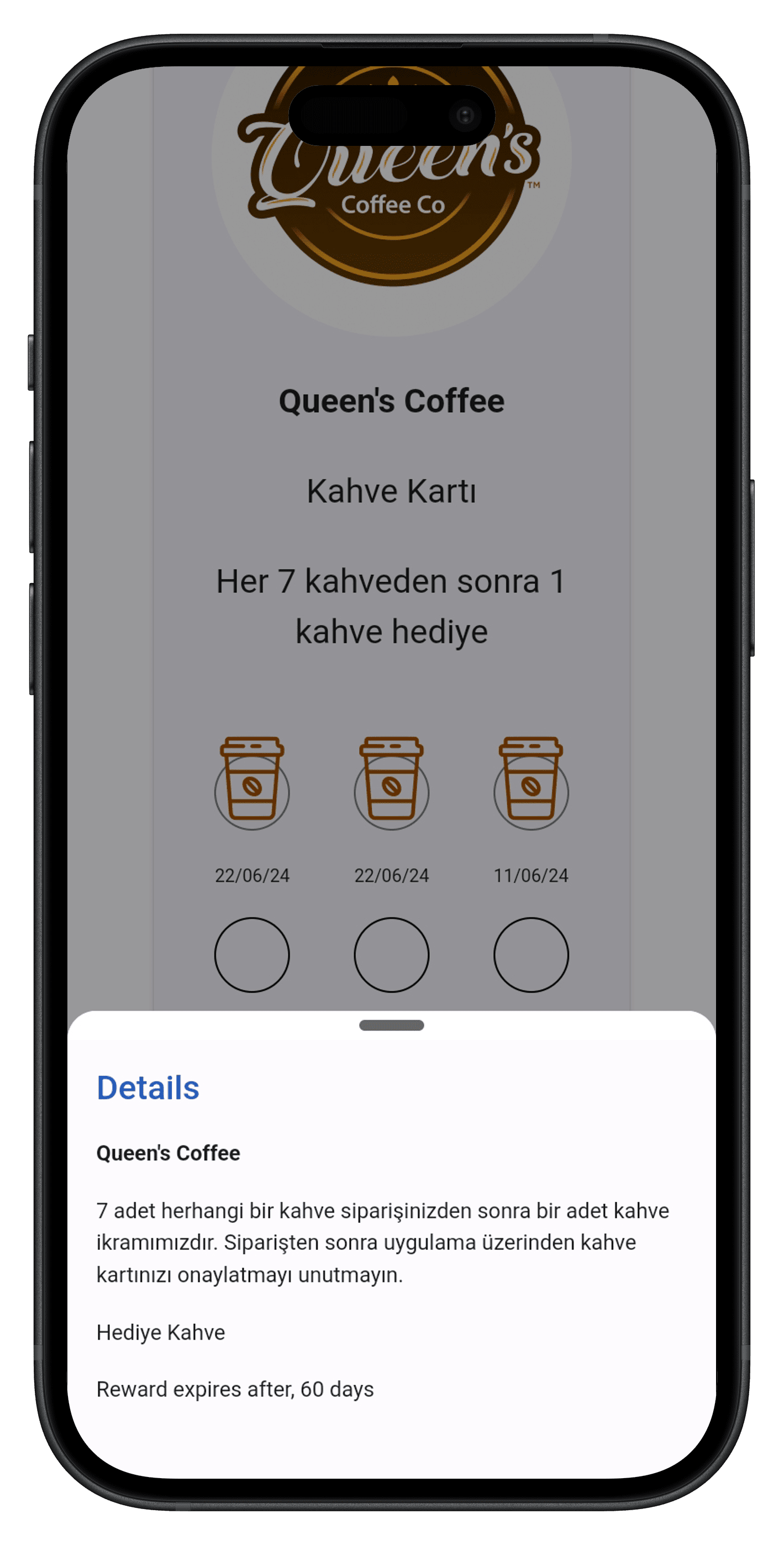
Letstamp's digital stamp cards allow businesses to define the number of stamps required to complete a card, configure the reward and set campaign and reward expiration rules.
Customers can view their active stamp cards and progress in the app instead of carrying a physical paper card. For a restaurant, that makes straightforward campaigns such as “complete 7 qualifying purchases and receive a reward” easier to manage digitally.
Explore Digital Stamp CardsHow to choose the right reward for your restaurant
The best reward is not necessarily the most expensive item on your menu. Look for something with clear perceived value, manageable fulfillment cost and a natural connection to another visit.
- Calculate the real cost of the reward before publishing the campaign.
- Choose a purchase threshold customers can realistically reach.
- Define exactly which purchases qualify for stamps or rewards.
- Make reward conditions simple enough for staff and customers to understand.
- Decide whether the campaign or earned reward needs an expiration period.
- Check which branches should issue and redeem the reward.
- Review campaign economics periodically instead of treating the setup as permanent.
Use different campaigns for different customer goals
A repeat-purchase card is useful when the goal is to encourage another visit, but restaurants may have other objectives as well. A new guest can receive a dedicated new customer campaign , while a birthday reward can create a reason to return around a customer's birthday.
Restaurants can also use customer segmentation to understand groups such as routine customers, customers who have lost their routine and customers with unused rewards. Relevant groups can then be selected for customer actions such as messages or gifts.
How restaurant staff process stamps and rewards
In Letstamp, a staff member can start a transaction using the transaction code on the customer's phone or by scanning the customer's QR code. For stamp transactions, the staff member selects the relevant campaign and number of stamps. When a customer has an available reward, it can be selected and redeemed through the reward transaction flow.
For restaurants that use supported POS integration, campaign rules can also be configured around synchronized products. Stamp Card and Reward Points campaigns can use selected trigger products, while reward products and product scope can be configured for applicable rewards.