
Getting someone to visit your restaurant once is only the beginning. Long-term growth also depends on giving satisfied customers a reason to return. A well-designed restaurant loyalty program can make that next visit more attractive by connecting purchases with visible progress, rewards and relevant offers.
Instead of relying on paper cards or disconnected promotions, restaurants can use a digital system to manage repeat-visit campaigns. Letstamp supports digital stamp cards , loyalty points and cashback , customer segmentation and other campaign models within the same loyalty platform.
What makes a restaurant loyalty program effective?
A useful restaurant loyalty program makes the path to the next reward easy to understand. Customers should know what action earns progress, what they can receive and how the reward can be used.
The reward should also match the restaurant's natural purchasing cycle. A stamp card can suit frequent repeat purchases, while reward points can work when order values and menu choices vary.
Why customer loyalty matters for restaurants
Restaurants compete for more than a customer's first order. After a positive visit, the next challenge is staying relevant when that customer decides where to eat again.
Loyalty programs create a structured reason to return. Instead of treating every purchase as an isolated transaction, the restaurant can connect multiple visits through progress and rewards. This is the basic idea behind using loyalty cards in restaurants .
The goal is not simply to distribute discounts. A stronger strategy rewards behavior that is useful to both the customer and the restaurant: returning regularly, completing a stamp card, earning points or redeeming a relevant reward.
Restaurant loyalty campaign ideas you can build with Letstamp
The best campaign model depends on how customers normally buy from your restaurant. A fast-casual restaurant with frequent visits may need a different structure from a restaurant where customers visit less often but spend more per order.
Digital Stamp Card
Give customers stamps for qualifying purchases and define a reward when they complete the required number of stamps.
Reward Points
Let customers earn points based on their spending and use those points according to the rules of your campaign.
New Customer Reward
Create a campaign specifically for first-time customers and provide a reward after their first qualifying transaction.
Birthday Reward
Give eligible customers a birthday reward and create a personalized reason to reconnect with your restaurant.
How digital stamp cards work in a restaurant
Digital stamp cards take the familiar "buy several, get a reward" model and move it into the customer's mobile experience. The restaurant defines the number of required stamps, campaign conditions, completion period and reward settings.
For example, a sushi restaurant could create a card that rewards customers after a defined number of qualifying orders. A pizza restaurant could create a card around repeat pizza purchases, while a quick-service restaurant could reward regular lunch visits. The exact number of stamps and the reward should be based on the restaurant's margins, visit frequency and customer behavior.
Make progress easy for customers to follow
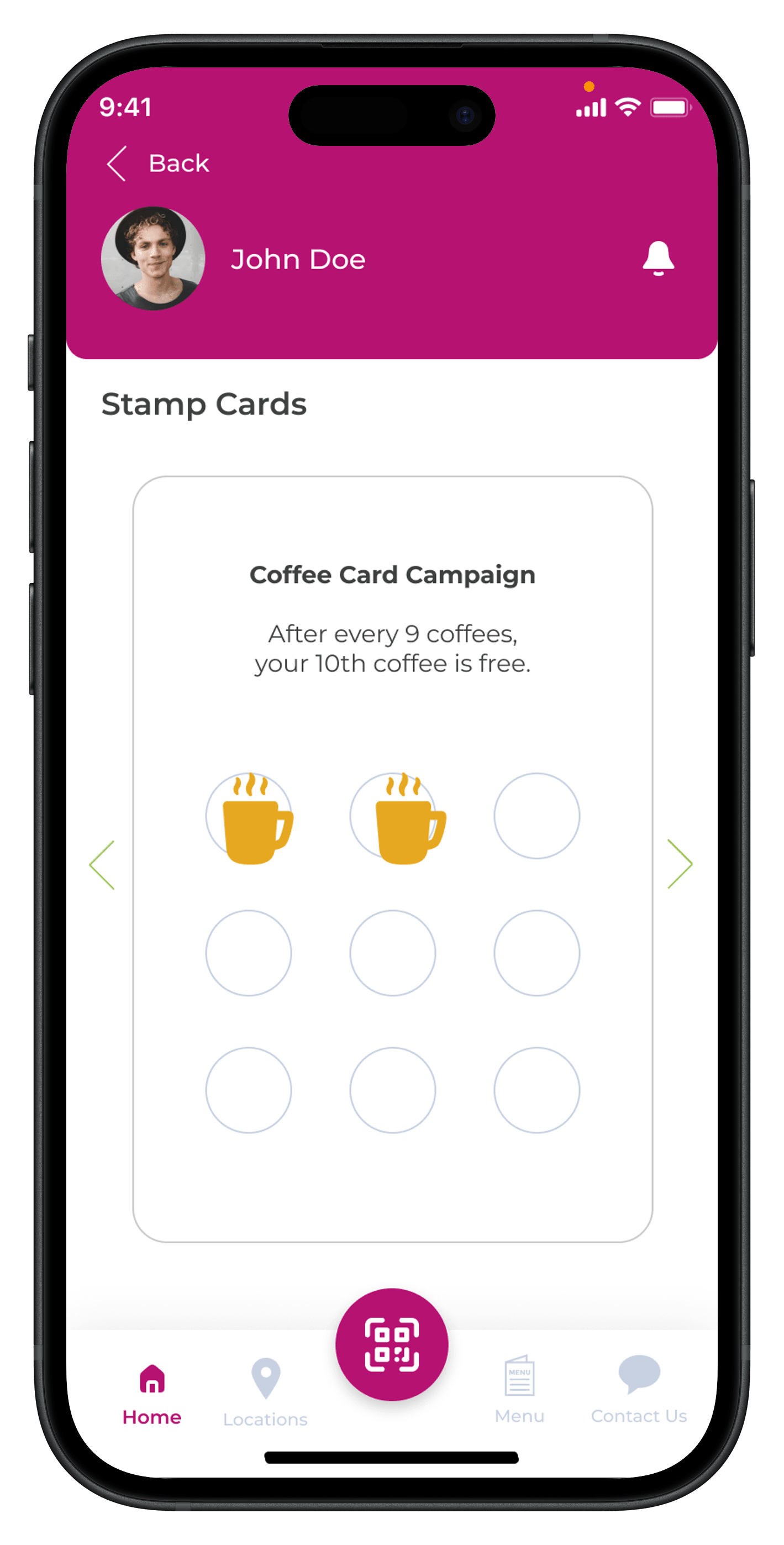
A loyalty mechanic becomes easier to understand when customers can see the progress they have already made toward a reward. Letstamp customers can view their active stamp cards and the stamps they have collected in the mobile app.
At the restaurant, a stamp transaction can be started using the transaction code from the customer's phone or by scanning the customer's QR code. The relevant number of stamps can then be processed for the customer's campaigns.
When reward points make more sense than stamps
Not every restaurant has a purchase pattern that fits a fixed stamp card. If order values vary significantly, a spending-based reward model may be more appropriate.
With Letstamp's reward points model, a restaurant can configure points as a fixed amount after a spending threshold or as a percentage of spending. Minimum order amounts, maximum earnable points and expiration settings can also be defined for the campaign.
| Loyalty Model | How It Works | Useful For |
|---|---|---|
| Digital Stamp Card | Customers collect a defined number of stamps and can earn the configured reward after completing the card. | Frequent and predictable repeat purchases |
| Reward Points | Customers earn points according to configured spending rules. | Restaurants with varying order values |
Move beyond the same promotion for every customer
A restaurant's customer base is rarely one uniform group. Some customers visit regularly, some have only visited once, and others may have stopped following their previous routine. Treating all of them identically can make communication less relevant.
Letstamp's customer segmentation provides predefined behavioral segments that can be customized according to customer routines. These include groups such as one-time customers, routine customers, customers who lost their routine and passive users.
This gives restaurants a more structured way to think about retention. A regular guest may not need the same message as someone who has not returned for a while.
Keep customers connected between restaurant visits
A loyalty program does not have to become invisible after the customer leaves the restaurant. Letstamp allows businesses to select customers and send push notifications or SMS messages . Messages can also be scheduled for a future time.
Communication should have a clear purpose. A useful message might remind a customer about an available reward, introduce a relevant campaign or reconnect with a customer segment rather than sending constant generic promotions.
A simple restaurant loyalty strategy
You do not need to launch every campaign type at once. Starting with one understandable mechanic makes it easier to evaluate how the program fits your restaurant and customer routine.
1. Choose the behavior
Decide whether you want to reward repeat visits, specific purchases or customer spending.
2. Define the reward
Select a reward that is attractive to customers while still making sense for your restaurant.
3. Set clear rules
Configure the required stamps or spending rules, reward conditions, expiration settings and relevant branches.
4. Refine your audience
Use customer behavior and segmentation to make future campaigns and communication more relevant.
Avoid making the reward too complicated
Customers should not need to decode a long set of conditions before understanding a loyalty campaign. The earning action, required progress, reward and validity conditions should be clear.
The same principle applies to reward economics. An extremely distant reward may feel irrelevant, while a reward that is too generous may not make commercial sense for the restaurant. Build the campaign around your actual purchase frequency, average order pattern and margins rather than copying another restaurant's numbers.
Build loyalty around the entire customer journey
A stamp card can be an excellent starting point, but restaurant loyalty can extend beyond a single campaign. A new customer campaign can address the first visit, stamp cards or points can support repeat behavior, birthday rewards can create a personal moment, and segmentation can help the restaurant communicate differently with different customer groups.
This is why a loyalty program should be treated as an ongoing customer strategy rather than a one-time promotion. For additional campaign structures, explore examples of loyalty campaigns for restaurants and the broader guide to customer loyalty models with Letstamp .