A cashback loyalty program gives customers value back after they spend instead of reducing the price before the purchase. With Letstamp, this model is built around Reward Points: your business defines how customers earn points, and those points can later be redeemed through the loyalty experience.
The idea is simple. A purchase does not have to end when the customer pays. By giving the customer something to use later, you create a practical reason for another visit. This makes spend-based rewards useful for businesses that want to encourage repeat purchases without relying entirely on instant discounts.
Letstamp lets you configure both fixed Reward Points and spending-based Reward Points. If you want a closer look at the feature itself, see Loyalty Points & Cashback .
How does cashback work in Letstamp?
You create a Reward Points campaign and decide how customers earn. The reward can be a fixed amount after reaching a spending threshold or a percentage of the purchase amount.
You can also set a minimum order amount, cap the maximum points earned in a transaction, define how long earned points remain valid, and choose whether the campaign is visible to customers.
Cashback vs. an instant discount: what changes?
An instant discount reduces what the customer pays today. A cashback-style Reward Points campaign keeps the current transaction intact and gives the customer value to use later.
That difference matters for customer retention. An immediate discount can help close a purchase, but the relationship may end at checkout. Reward Points create an unfinished value loop: the customer has earned something and can return to use it.
| Model | Customer Value | When Value Is Used | Main Loyalty Role |
|---|---|---|---|
| Instant Discount | Purchase price is reduced | Current transaction | Immediate purchase incentive |
| Reward Points / Cashback | Reward Points are earned | Future redemption | Encouraging another interaction or visit |
Choose how customers earn Reward Points
Not every business needs the same earning model. Letstamp supports two useful approaches, allowing the campaign to match your average order value, margins, and customer buying habits.
Percentage-Based Reward Points
Customers earn Reward Points proportional to the amount they spend. For example, a 5% campaign can reward $5 in points on a qualifying $100 purchase.
Fixed Reward Points
Award a fixed amount of Reward Points when a customer reaches the spending condition you define, such as a set reward after a qualifying order.
How a percentage-based cashback campaign works
Suppose your business runs a 10% Reward Points campaign with a $25 minimum order amount. A customer who makes a qualifying $80 purchase would earn $8 in Reward Points, provided the transaction does not exceed any maximum earning cap you have configured.
A percentage model is easy for customers to understand because the reward grows with spending. At the same time, the maximum earnable Reward Points setting gives the business a way to place a ceiling on unusually large transactions.
$80 Purchase
The customer completes an order that meets the campaign's minimum spending requirement.
$8 in Reward Points
At a 10% earning rate, the qualifying transaction generates $8 in Reward Points for the customer.
Configure the campaign around your economics
The earning percentage is only one part of the campaign. A sustainable cashback program also needs rules that determine when points are earned, how much can be earned, and how long the resulting balance remains available.
- Choose a clear campaign name and description.
- Decide between fixed or percentage-based Reward Points.
- Set the minimum order amount required to earn points.
- Define the Reward Points rate for percentage-based campaigns.
- Add a maximum earning cap when needed.
- Decide how long earned Reward Points remain valid.
- Choose an unlimited or timed campaign duration.
- Confirm whether the campaign should be visible to customers.
These settings should work together rather than being chosen independently. A generous earning rate may make sense with a higher minimum spend or a maximum reward cap, while a smaller reward may need fewer restrictions to remain attractive.
For a deeper campaign-planning checklist, read what to consider when creating a Reward Points campaign .
Customers can follow what they earn and spend
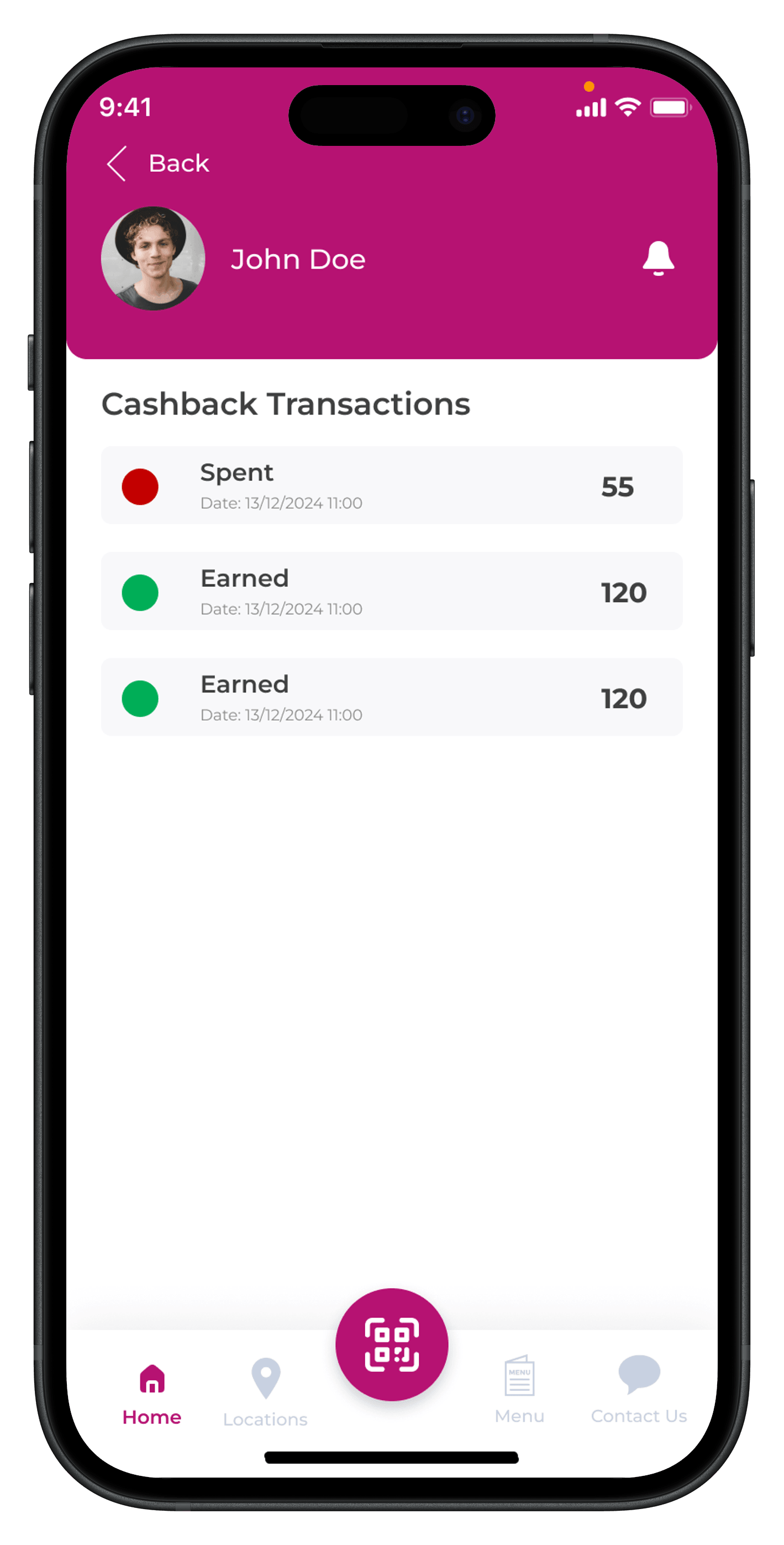
The Letstamp cashback transaction screen gives customers a history of Reward Points they have earned and spent. This makes the loyalty value easier to follow instead of turning points into an invisible benefit.
A clear balance history is especially useful when the program runs continuously. Customers can see that previous purchases have created value and understand that their accumulated Reward Points can be used later.
How Reward Points transactions work in Letstamp Partners
For manual Reward Points transactions, the process starts with the customer's transaction code or QR code. Staff can then process earning or redemption from the Letstamp Partners panel.
1. Identify the Customer
Ask for the transaction code shown on the customer's phone or scan the customer's QR code to begin.
2. Enter the Sale
Select the Reward Points transaction and enter the sale amount in the Partners panel.
3. Reward Points Are Added
Letstamp applies the configured campaigns and adds the resulting points to the customer's account.
4. Redeem Reward Points
When the customer wants to spend points, identify them again, choose Use Reward Points, enter the amount, and complete the redemption.
Multiple eligible campaigns can be processed together
During a Reward Points earning transaction, Letstamp can process the customer's applicable campaigns together rather than requiring a separate transaction for each campaign.
Why cashback can support repeat purchases
Cashback is useful because the reward is connected directly to customer spending while its value continues beyond the current transaction. Instead of treating each purchase as an isolated event, the loyalty program connects today's spend with a future redemption opportunity.
This structure can sit alongside other loyalty mechanics. Some businesses may use Reward Points as their main program, while others combine them with digital stamp cards for visit-based behavior or other campaign types for specific customer moments.
If you are deciding which loyalty structure makes the most sense for your business, the guide to three customer loyalty models with Letstamp provides a broader comparison.
Cashback campaign ideas for different businesses
The same Reward Points tools can support different campaign strategies. The right setup depends on purchase frequency, average transaction size, margin, and how soon you want customers to return.
Frequent-Purchase Campaign
Use a simple percentage-based reward for businesses where customers make smaller but recurring purchases.
Minimum-Spend Campaign
Require a qualifying order value before Reward Points are earned when you want the campaign to focus on larger baskets.
Capped Cashback Campaign
Combine a percentage earning rate with a maximum Reward Points limit to control the reward on high-value purchases.
Time-Limited Reward Balance
Give earned Reward Points a defined validity period when the campaign strategy is designed around a shorter return window.
Reward Points can be part of a wider loyalty program
A spend-and-earn campaign does not need to operate in isolation. Letstamp includes different loyalty and engagement tools that can support different stages of the customer relationship.
For example, businesses can use customer segmentation to understand different customer behaviors, then use push notifications or SMS messaging to communicate relevant offers.
Reward Points can also connect to the Product Catalog , where customers can spend their accumulated points on products supplied by the business.
Turn customer spending into a reason to return
Create a Reward Points campaign, define how customers earn, control minimum spending and reward limits, and manage the experience through Letstamp.